
There are some stories that stop you in your tracks.
Not because they are only painful, but because they are familiar. Because they remind us that communities of color have not been afraid of medicine for no reason. We have been afraid of being unheard. We have been afraid of being experimented on. We have been afraid of being dismissed, misused, and then told to trust a system that never came back to apologize.
The recent lawsuit involving the families of Ross Otto Hambrick and Victor Marcellus King is one of those stories.
According to a 2026 announcement from attorney Ben Crump and co-counsel, the families have filed a federal civil lawsuit against the United States government. The complaint alleges that Ross Otto Hambrick and Victor Marcellus King, two Black infants, were enrolled in an NIH-sponsored experimental RSV vaccine trial in 1965–66 without their families’ knowledge or consent. Both babies died in January 1967. These are allegations in a newly filed lawsuit and have not yet been proven in court, but the story itself raises painful and necessary questions about consent, research ethics, race, and accountability. (Ben Crump)
And for me, as a healthcare professional and advocate, this is personal.
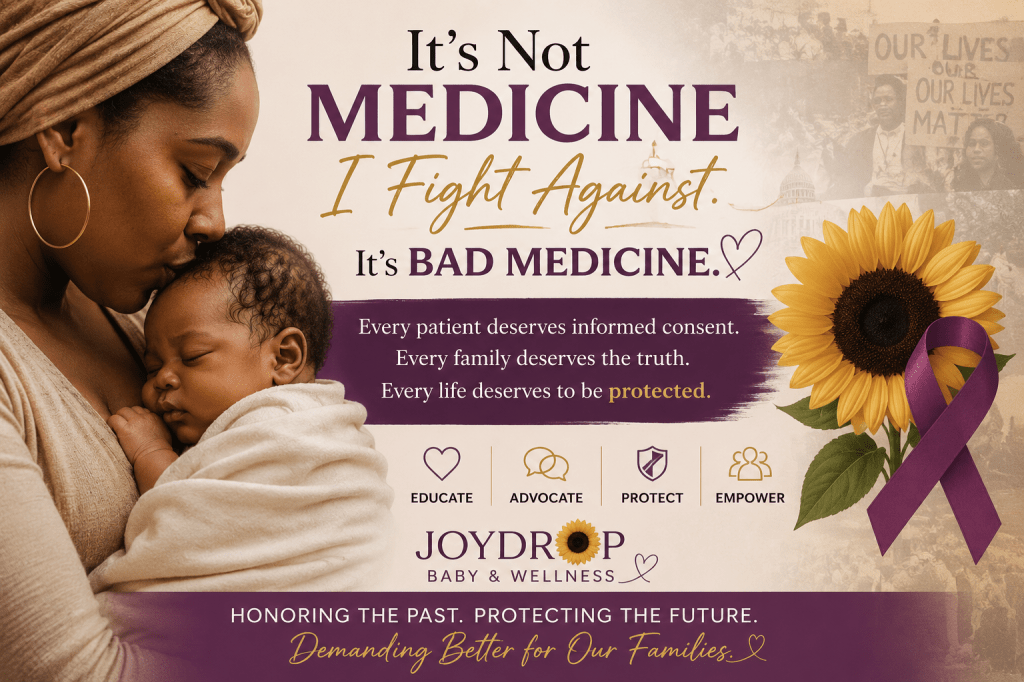
Because my fight has never been against medicine.
My fight is against bad medicine.
Medicine without consent.
Medicine without transparency.
Medicine without dignity.
Medicine that treats vulnerable people like data instead of human beings.
Medicine that benefits from Black bodies but forgets Black families.
That is the fight.
When Research Forgets the Family
The allegations in this case are deeply disturbing. The complaint states that the infants were part of an experimental RSV vaccine trial involving a vaccine known as “Lot 100.” The lawsuit alleges that Black infants from low-income families were targeted because they were vulnerable, and that after the babies died, tissue samples from their autopsies later informed RSV vaccine research. (Ben Crump)
A 2023 Undark investigation also examined this history, reporting that Ross Otto Hambrick and Victor King were among children involved in early RSV vaccine studies and that family members said they did not learn the full story until decades later. (Undark Magazine)
Let that sit for a moment.
Families lost their babies.
Science moved forward.
And according to the families, they were left without the truth, without acknowledgment, and without justice.
That is not how healing works.
That is not how trust is built.
This Is Not an Anti-Vaccine Conversation
I want to be very clear: this is not an anti-vaccine conversation. This is not about telling people to run from healthcare, reject treatment, or ignore medical advice.
This is about ethical care.
This is about informed consent.
This is about honest communication.
This is about research protections.
This is about making sure families understand what is being done to them, what is being offered, what the risks are, and what their rights are.
Modern research has rules that are supposed to protect human participants. Federal guidance states that informed consent must be legally obtained and documented, and NIH policy requires informed consent for human subjects in FDA-regulated research, except under specific regulatory exceptions. (HHS.gov)
But rules only matter when systems follow them.
Policies only protect people when someone is watching.
And trust only grows when communities are treated with respect before harm happens not after.
Why This Still Matters in 2026
Some people may want to say, “That happened a long time ago.”
But history is not old when the impact is still alive.
In 2026, we are still talking about Black maternal mortality.
We are still talking about women not being listened to when they report pain, bleeding, headaches, swelling, shortness of breath, or symptoms that feel wrong.
We are still talking about late cancer diagnoses.
We are still talking about chronic kidney disease being missed until it becomes severe.
We are still talking about families who do not know what questions to ask because nobody took the time to educate them.
And we are still talking about medical mistrust as if it came from nowhere.
It did not come from nowhere.
It came from stories like this.
It came from Tuskegee.
It came from Henrietta Lacks.
It came from women being sterilized without full understanding.
It came from Black pain being underestimated.
It came from research and medicine that sometimes advanced while communities were left wounded.
So when people say, “Why don’t they trust the system?” my response is:
What has the system done consistently to prove it can be trusted?
That is the real question.
Good Medicine Requires Consent
Good medicine explains.
Bad medicine assumes.
Good medicine asks.
Bad medicine takes.
Good medicine respects the patient’s right to understand.
Bad medicine hides behind authority.
Good medicine says, “Here are your options. Here are the risks. Here are the benefits. What questions do you have?”
Bad medicine says, “Just trust us.”
And I need people to understand: informed consent is not just a signed form.
It is a conversation.
It is comprehension.
It is time to ask questions.
It is the right to say yes.
It is also the right to say no.
This Is Why Advocacy Matters
This is why I do the work I do.
Because people should not have to be medical experts to be treated with dignity.
A mother should not have to beg for someone to check her blood pressure.
A postpartum woman should not have to convince someone that heavy bleeding is serious.
A patient should not have to be wealthy, educated, or connected to receive clear explanations.
A family should not have to wait sixty years to learn the truth.
Advocacy matters because healthcare is powerful. When done well, it saves lives. When done poorly, it can cause harm that echoes for generations.
And that is why I will always stand for preventive care, informed consent, patient education, maternal safety, and accountability.
What Families Should Ask
If you or someone you love is receiving care, participating in research, starting a new treatment, or being offered a procedure, it is okay to ask questions.
Ask:
- What is this medication, test, study, or procedure for?
- Is this standard care or research?
- What are the risks and benefits?
- Are there other options?
- What happens if I say no?
- Will my samples, tissue, blood, or data be used later?
- Who do I contact if something goes wrong?
- Can I take this information home and review it?
- Can I bring someone with me to help listen?
You are not being difficult.
You are being informed.
You are protecting yourself and your family.
The Joydrop Wellness Position
At Joydrop Wellness, we believe in medicine that is ethical, compassionate, transparent, and preventive.
We believe in vaccines when they are appropriately studied, explained, monitored, and consented to.
We believe in clinical trials when participants are respected, protected, and fully informed.
We believe in hospitals, doctors, researchers, nurses, and care teams that honor the humanity of every patient.
But we do not believe in blind trust.
We believe in earned trust.
We believe in accountability.
We believe every patient deserves to know what is happening to their body.
In Memory of the Children Whose Names Must Be Spoken
Ross Otto Hambrick.
Victor Marcellus King.
Their names matter.
Their families matter.
Their story matters.
And whether this lawsuit results in legal accountability or not, the moral question remains: how many families have carried grief while institutions carried credit?
That question should bother every person who cares about healthcare.
Because healthcare should never advance by leaving the vulnerable behind.
A Call to Action
This is my message to families, patients, providers, researchers, and institutions:
Do not confuse silence with trust.
Do not confuse consent with paperwork.
Do not confuse medical progress with medical justice.
If we want healthier communities, we must build systems worthy of trust.
That means telling the truth.
That means listening when patients speak.
That means protecting vulnerable families.
That means explaining research clearly.
That means acknowledging harm.
That means changing practices before another family has to fight for answers decades later.
My fight is not against medicine.
My fight is for medicine that heals without harming.
Medicine that listens.
Medicine that explains.
Medicine that respects.
Medicine that protects.
Because our communities deserve more than access to care.
We deserve safe care.
We deserve honest care.
We deserve ethical care.
We deserve good medicine.
And we will keep advocating until that becomes the standard not the exception. 🌻
