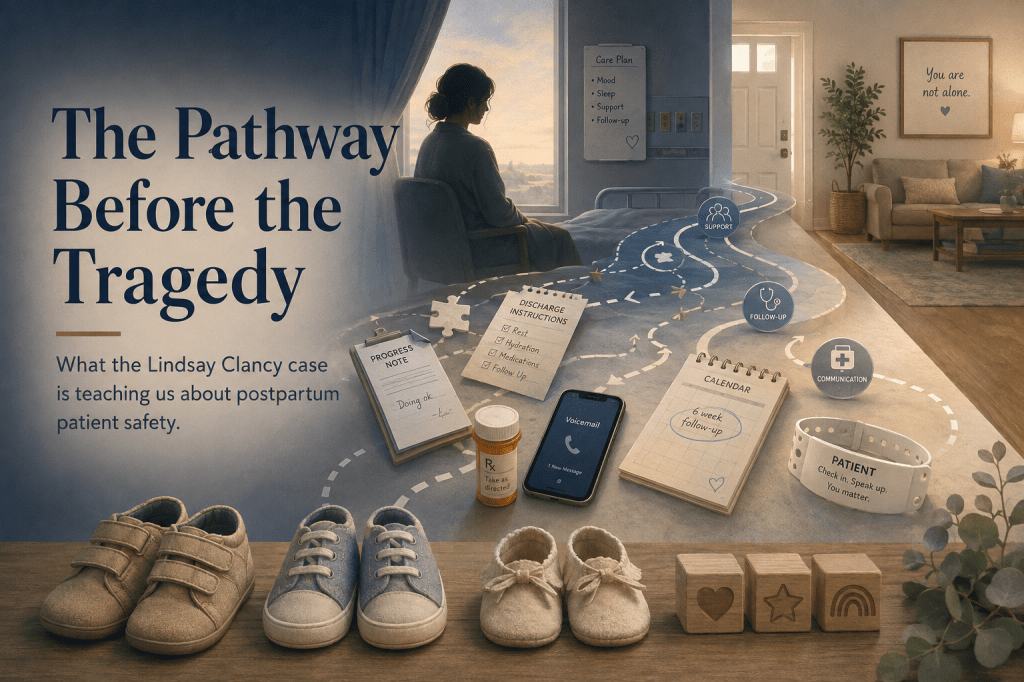
What the Lindsay Clancy Case Is Teaching Us About Postpartum Patient Safety
As the Lindsay Clancy trial nears its conclusion, much of the public conversation has centered on one question: Was Lindsay Clancy psychotic when she killed her three children?
The experts disagree.
Defense psychiatrists have testified that Clancy experienced postpartum psychosis and bipolar illness. A prosecution rebuttal psychiatrist concluded that she suffered from major depression but did not find sufficient evidence of psychosis or bipolar disorder.
The jury will ultimately have to consider those competing opinions in deciding the legal questions before it.
But my patient-safety investigation has been asking something different.
What happened along the pathway before January 24, 2023?
And where, if anywhere, could that pathway have been interrupted?
Cora, Dawson and Callan Clancy are the victims of this tragedy. Examining their mother’s healthcare does not change that. The reason to study Lindsay’s deterioration is to understand whether anything we learn from this case could help prevent another mother and another group of children from reaching such a catastrophic point.
She Was Getting Help
One of the first assumptions I had to reconsider while following this case was the idea that Lindsay simply could not get mental-health treatment.
That is not what the evidence shows.
She saw psychiatric providers. She participated in a perinatal behavioral-health program. She received numerous psychiatric medications. Her family became involved. Emergency evaluations occurred. Higher levels of treatment were discussed and sought. And shortly before the children’s deaths, she spent several days hospitalized at McLean Hospital.
There was help.
So my question changed.
Why didn’t all of that help result in sustained stabilization?
That question has led me to several pathway concerns.
Concern No. 1: No One Person Appears to Have Had the Entire Story
Lindsay interacted with multiple clinicians and institutions.
But testimony revealed something important: clinicians did not necessarily know everything that other clinicians knew.
One psychiatric provider testified that she had not realized Lindsay was simultaneously being treated by another psychiatrist.
Family members also possessed information that apparently did not always reach the healthcare professionals treating her.
That creates a classic patient-safety problem.
When several clinicians are treating one deteriorating patient, who owns the complete clinical picture?
Who reconciles the diagnoses?
Who reconciles the medications?
Who makes sure an emergency-department visit reaches the outpatient psychiatrist?
Who makes sure the next clinician understands what happened with the previous medication?
Who recognizes that what looks like several separate encounters may actually be one worsening trajectory?
Healthcare can become fragmented even when everyone involved is trying to help.
Concern No. 2: A Doctor Cannot Respond to Information the Doctor Does Not Have
This case has also challenged me to look beyond the healthcare system itself.
Lindsay appears to have been very forthcoming about some things. Her anxiety, insomnia, depression, medication concerns and suicidal thoughts were discussed repeatedly.
But some of the most alarming information was apparently not communicated to every clinician caring for her.
Family testimony indicated that Lindsay had discussed thoughts involving harm to the children. Yet at least one treating psychiatrist testified that she did not know about that disclosure.
Then there is the reported male voice that the defense says commanded Lindsay to kill the children and herself. That became a major component of the defense’s explanation of her mental state, but prosecutors have emphasized that such a command hallucination was not documented by the clinicians treating her before January 24.
That doesn’t automatically tell us the later account is true or false.
It does tell us something critically important for patient safety:
Healthcare professionals cannot read a patient’s mind.
If a mother is experiencing thoughts that frighten her particularly thoughts involving suicide, harming a child, hearing voices, extreme paranoia or losing control those symptoms need to be communicated as clearly as possible.
And families need to understand that information shared around the kitchen table may also need to reach the clinical team.
Concern No. 3: Documentation Has to Tell the Story
As a paralegal I learned quickly that documentation rules the nation, and it so important to document everything related to a case big and small. Another issue raised during testimony was the quality of psychiatric documentation.
This matters far beyond one doctor or one case.
A medical record should do more than prove that an appointment occurred.
When a patient is deteriorating over weeks or months, the record should help the next healthcare professional understand the trajectory:
How much is she sleeping?
Are symptoms getting better or worse?
Are suicidal thoughts becoming more frequent?
What exactly does she mean by “intrusive thoughts”?
Has her ability to care for herself or her children changed?
How did she respond to the last medication?
Why was another medication added?
Why was something stopped?
What did the family report?
What prompted or did not prompt a higher level of care?
Good documentation becomes particularly important when the patient moves between providers.
If the healthcare system is fragmented, the medical record may be the only thread connecting the pieces.
Concern No. 4: Medication Lists Are Not the Same as Medication Understanding
The number of psychiatric medications associated with Lindsay’s treatment understandably received enormous attention during this case.
But simply counting prescriptions does not answer the patient-safety question.
What matters is what she actually took, when she took it, at what dose, what she stopped, why it was stopped, what symptoms followed and whether the next prescriber knew what happened.
A medication can appear in an electronic record without telling the next physician the entire story.
And this is another place where patients can help protect themselves.
Bring the medication list.
Tell every provider who prescribed each medication.
Tell them what you stopped.
Tell them exactly what happened when you took it.
Do not assume that because two doctors use computers, they automatically see the same complete medical record.
Concern No. 5: What Happened After Hospital Discharge?
For me, one of the most important periods in the entire case remains the discharge period, the 19 days between Lindsay’s January 5 discharge from McLean Hospital and January 24.
Psychiatric hospitalization is an escalation in care.
But discharge is not the end of treatment.
It is a transition.
So I continue to ask:
What information followed her home?
What did the outpatient clinicians know about the hospitalization?
What did the family understand about warning signs?
What would trigger a return to the emergency department?
Who was watching sleep?
Who was watching medication response?
Who was watching for returning suicidal thoughts?
And who was determining whether the improvement sufficient for hospital discharge remained stable once she returned to caring for three young children?
Those are transition-of-care questions, and healthcare has learned in many other areas that transitions are vulnerable points for patients.
Postpartum psychiatric care should be no different. And I’m not saying I’m an expert in psychiatric care, but with something of that level of care I would have thought that some type of follow up would have followed.
This Is Not Simply a Story About Healthcare Failure
Following this trial has changed my thinking in another important way.
It would be easy to examine Lindsay’s treatment and conclude that the healthcare system failed her.
That is too simple.
The pathway involves several possible contributors:
Healthcare systems may have allowed information to become fragmented.
Healthcare professionals had to make decisions based on the information available to them at particular moments.
Lindsay may not have disclosed everything she was experiencing.
Family members sometimes knew information that clinicians apparently did not.
And psychiatric illness itself can be complicated, evolving and difficult to recognize.
Those factors can exist simultaneously.
Patient-safety work is not useful if we begin with the conclusion and then search for someone to blame.
We have to follow the pathway.
What I Want New Mothers to Learn From This Case
There are lessons here even before a jury reaches a verdict.
Tell your healthcare provider the symptom you are most afraid to tell them.
If you have thoughts about hurting yourself or your baby, say it.
If you hear something other people don’t hear, say it.
If you have gone an extraordinary amount of time without sleeping, say it.
If medication makes you feel dramatically different, describe exactly what changed.
Tell each doctor who else is treating you.
Keep your medication information with you.
And if treatment isn’t working and your condition continues to deteriorate, keep asking for reassessment.
Families need education too.
If a mother tells you something frightening, don’t assume her psychiatrist already knows.
The Question I Will Carry Forward
The Clancy trial will eventually end.
The jury will decide the legal questions placed before it.
But that will not end the patient-safety questions.
Cora, Dawson and Callan deserve for us to ask them.
Not because understanding their mother’s illness diminishes what happened to them, but because preventing another child’s death may require understanding exactly how a mother’s deterioration reached the point where her children were no longer safe.
So the question I will continue carrying into my work on postpartum care is this:
What can healthcare professionals, hospitals, patients and families do earlier—before worsening symptoms become a psychiatric emergency and before a mother or child is harmed?
That is where prevention begins.
And that is why the pathway matters.
